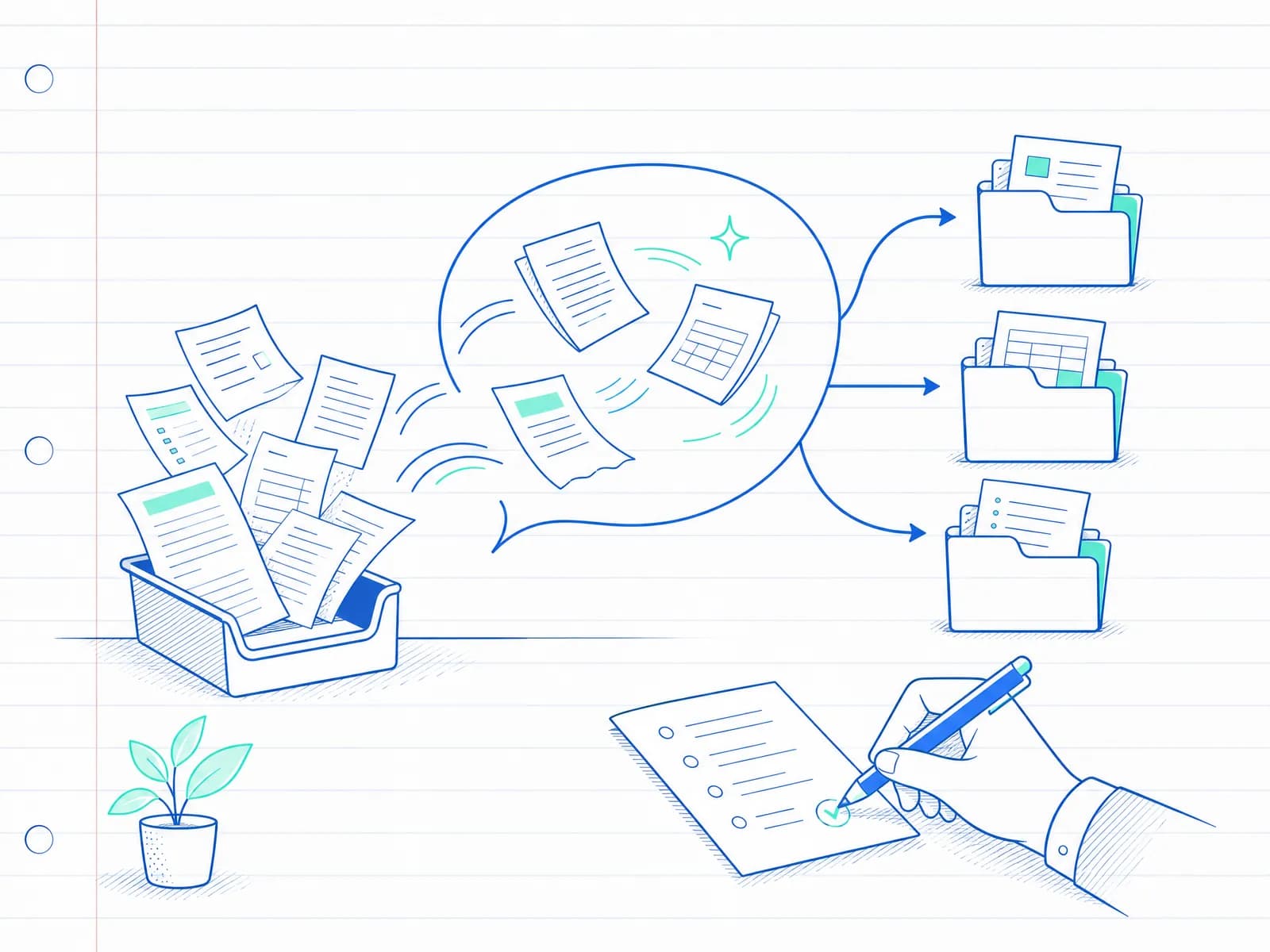
AI agents do the routine. Your team makes the decisions.
We build agents that sort documents, prepare reports and draft replies inside your own systems. Every important step waits for a person, and every action is logged.
UK: UK GDPR · ICO guidanceEU: GDPR · AI ActGermany: BDSG · BetrVGFor teams in the UK and the EU that handle documents, reports and support requests.
Approval queue
Supplier invoice matched to its orderPrepared
Weekly sales report draftedPrepared
Reply to a customer about a late parcelApprove
Approved by a person and logged
Example approval queue
What agents can do for your team
Three kinds of routine work an agent can take on. A person approves anything that leaves the building.
Paperwork off your team
Agents read incoming documents, invoices and forms, sort them and check them against your rules.
Invoices and forms read, sorted and filed
Payments matched to invoices, odd items flagged for a person
Offers and contracts drafted from your templates
Your numbers, clear every Monday
Your data lives in many tools. An agent pulls it into one view and writes a short report in plain words.
A weekly report ready on Monday morning
An alert when ad spend jumps or sales drop
Slow pages and broken links on your site, found on a schedule
Questions answered, requests sorted
An assistant answers your team's questions from company documents and turns support requests into clear tasks.
Answers to "where is X?" from your own documents
Support requests sorted into tasks
Draft replies to customers for a person to check and send
The agents we build
Each agent does one job inside the limits you set. It prepares the work and hands it to a person.
Documents and money
Document reader
Reads invoices, contracts, statements and forms, and pulls out each figure with a link to the page it came from.
Checks totals with fixed rules and flags documents that don't add up
Treats documents as data, so instructions hidden in a file are ignored
Who decides: Your team reviews every flagged field.
EU: GDPR · AI ActUK: UK GDPR
How it meets the rules
EU
GDPR Art. 5(1)(c) and 9
Only the fields the task needs; sensitive details are filtered out.
AI Act
Reading and sorting documents is not a high-risk use, as long as it is not used to decide about people, such as hiring or credit.
UK
UK GDPR Art. 5 and 9
Only the fields the task needs; sensitive details are filtered out.
Documents and money
Reconciliation and exceptions
Matches bank and payment-provider statements against your ledger with fixed rules and sends every exception to a queue with the evidence attached.
Amounts are matched by code; the model only reads messy references
Explains each exception and proposes a fix for review
Who decides: Your finance team resolves exceptions; postings need approval.
EU: GDPR · Audit trailUK: UK GDPR · Audit trail
How it meets the rules
EU
Matching by code
Numbers are never decided by a language model, so auditors can repeat every result.
GDPR Art. 5(1)(c)
Payer data is used for matching only; no profiles are built.
UK
UK GDPR Art. 5(1)(c)
Payer data is used for matching only, and every match and approval is kept on record.
Customers
Complaints handling
Sorts incoming complaints, gathers the order history and drafts a reply in your tone of voice, within your deadlines.
Tracks the reply deadline for every complaint
Flags complaints that need a manager
Who decides: A person reviews and sends every reply.
EU: GDPR · AI ActUK: UK GDPR
How it meets the rules
EU
GDPR Art. 22
No complaint is rejected automatically; a person decides every outcome.
AI Act Art. 50
If the agent ever writes to customers directly, it says it is an AI.
UK
UK GDPR, as amended by the Data (Use and Access) Act 2025
A person decides every outcome, so no significant decision is made by automation alone.
Customers
Customer service agent
Answers questions about orders, deliveries and returns on your website or in chat, and opens requests in your systems.
Hands the conversation to a person with the full context
Answers in the customer's language
Who decides: A person is one tap away at every step.
EU: AI Act · GDPR · Accessibility ActUK: UK GDPR
How it meets the rules
EU
AI Act Art. 50
Says it is an AI assistant in its first message.
European Accessibility Act
The chat is built to WCAG 2.2 AA, above the WCAG 2.1 AA level behind the Act's standard (EN 301 549).
UK
UK GDPR
Chats are kept only as long as your policy says, and customers can always ask for a person.
Your team
Internal knowledge agent
Answers staff questions from approved policies, procedures and product documents. Every answer shows its source.
Says so when no approved source exists instead of guessing
Respects the access rights of each document
Who decides: Document owners approve what the agent may use.
EU: GDPR · AI ActUK: UK GDPRGermany: BetrVG
How it meets the rules
EU
GDPR Art. 5(1)(c)
No customer data in the index; query logs are kept without ranking employees.
AI Act Art. 4
Comes with short training material so staff know how to use and check it.
UK
UK GDPR
No customer data in the index, and no ranking of staff from their questions.
Germany
BetrVG § 87(1) no. 6 and § 90
Query logs can't be used to monitor staff, and you get the documents to inform your works council early.
Your team
Weekly report and alerts
Pulls ads, website, shop and email figures into one view and writes a short weekly report in plain words.
Alerts when ad spend jumps or sales drop
Suggests next steps for a manager to approve
Who decides: A manager approves every action.
EU: GDPRUK: UK GDPR
How it meets the rules
EU
GDPR Art. 5(1)(c)
Works on totals by channel and campaign, not on profiles of individual customers.
UK
UK GDPR
Totals by channel and campaign, not individual profiles.
The rule mapping shows how we design each agent. Your legal and data protection advisers confirm it for your deployment.
How an agent works
One controlled layer over the tools you already use. It replaces nothing.
1
Step 1: Connect
Read-only access to the tools each task needs, nothing more.
2
Step 2: Set the rules
You decide what the agent may read, prepare and change, and sign it off.
3
Step 3: The agent prepares
Reports, drafts and sorted documents, each with its sources.
4
Step 4: A person approves
Accept, change or reject. Every action and approval is logged.
How much an agent may do
Level 0, read. The default for every agent. It looks up, compares and prepares.
Level 1, act within limits. Low-risk actions you list, such as tagging a document or opening a ticket.
Level 2, one person confirms. Sending a reply to a customer waits for one approver.
Level 3, four eyes. Anything that touches money, prices or a customer's account. Off by default.
Your data stays where it is
Agents run where your data already lives. You choose the model and the place it runs, under your own contract with the provider.
66%
57% of German companies with 20+ staff use AI. Data-protection requirements are the most-cited obstacle, named by 66% of AI users.
Germany · Bitkom, 14 September 2026; 603 companies
Your cloud account
Models in the UK or EU region of your AWS, Azure or Google Cloud account.
Your own servers
Open-weight models such as Mistral, Llama or Qwen. Nothing leaves your network.
A European cloud
A provider based in Europe, such as STACKIT or IONOS, when your buyers ask for it.
Hybrid
A small local model handles every step with personal data. A larger model sees only masked text.
What we promise
Our engineers don't see your live data by default. Any access is approved, supervised and recorded by your team.
Neither we nor the model provider train on your prompts, documents or outputs, and the contract says so.
You can change models without rebuilding the agents.
Data, prompts and agent settings export in open formats, so you can leave.
Built for UK and EU rules
We design each agent against the rules that apply where you work and give your advisers the documents that show how. They confirm the setup before any real customer data is used.
United Kingdom
UK GDPR and the Data Protection Act 2018
A lawful basis for every task, only the data it needs, an impact assessment where one is needed, and safeguards for automated decisions as amended by the Data (Use and Access) Act 2025.
ICO guidance
Built to the ICO guidance on AI and data protection.
European Union
GDPR
A lawful basis for every task, only the data it needs, and a person deciding anything about a person (Art. 22).
EU AI Act
Agents say they are AI when people talk to them (Art. 50), no prohibited practices (Art. 5), and a documented risk class for each agent.
Germany adds
Scoring of individuals is kept out of the standard setup (§ 37a BDSG, from 20 November 2026)
A works agreement template and the documents to inform your works council early (§ 87(1) no. 6 and § 90 BetrVG)
What our agents never do
Decide about a person, such as hiring, credit or refusing a customer
Score people on personality, emotions or social media
Send anything to a customer above the approval level you set
Train models on your data
Move money or change prices without a person's approval
What your advisers receive
A data processing agreement (UK GDPR and GDPR)
Technical and organisational security measures
An impact assessment template with the technical part completed
A risk class for each agent under the EU AI Act
AI disclosure texts for every channel
An approval matrix: automatic, needs sign-off, never automated
Start with one task
A small first step your team can sign off quickly. Bigger agents follow under the same rules.
1
Step 1: A short call
We talk through one task that takes your team hours each week.
2
Step 2: Assessment and estimate
We assess the task and the data it touches, then send you an estimate.
3
Step 3: Contract
You sign the contract. Setup starts only then.
4
Step 4: The first agent
A low-risk task first, such as sorting documents or the weekly report. It runs on past data before anyone relies on it.
When an agent needs your shop
MCP services
If an agent or an AI assistant needs your catalogue, stock or orders, we build the MCP server it connects through.
The one that fits the task and the place your data must stay: a model in your own cloud account, or an open-weight model on your servers. We test each task with the model you choose before it goes live.
Can an agent act on its own?
Only within the limits you set. By default agents read and prepare. Sending, paying or changing anything waits for a person.
Do you see our data?
Not by default. Agents run in your accounts, and our support works from logs and metadata. Any access to live data is approved, supervised and recorded by your team.
Is this only for shops?
No. Agents help any team that handles documents, reports and support requests. If you sell online, they can also reach your catalogue through an MCP server.
How much does it cost?
We estimate each task after a call about it. Setup starts once the contract is signed.
Start small
Let's find your first agent
Tell us about one task that takes your team hours each week. We'll suggest where an agent can help and what it needs.